

Veronika Hrebinchuk
PhD Candidate in Epidemiology at the ASU-GHI
Biography
Veronika Hrebinchuk is a PhD candidate in Epidemiology at Sorbonne University, within the Pierre Louis School of Public Health (ED393). She is affiliated with the Pierre Louis Institute of Epidemiology and Public Health (UMRS 1136), in the Surveillance and Modeling of Communicable Diseases (SUMO) team. She holds a Master’s degree in Bioinformatics and Structural Biology from Taras Shevchenko National University of Kyiv, Ukraine.
Her thesis, funded by a France Excellence Eiffel scholarship, focuses on advancing global health through an innovative approach to the surveillance and control of tick-borne diseases: MALDI-TOF mass spectrometry combined with artificial intelligence. The project is led by Cécile Nabet, Raphaëlle Metras, and Xavier Tannier.
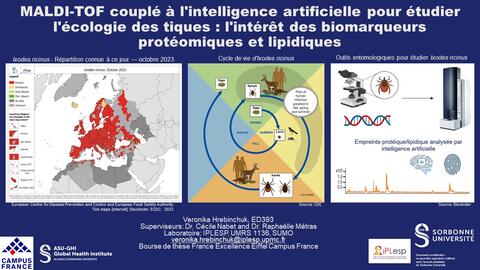
Climate and environmental changes are allowing ticks to expand into new regions and remain active for longer periods each year. As a result, people are exposed to potentially infected tick bites more often, this highlights the need to understand the transmission risk patterns.
The species of interest in this thesis is Ixodes ricinus, a hard tick and the main vector of Lyme borreliosis and tick-borne encephalitis, both major public health threats in Europe. Ixodes ricinus has a complex life cycle lasting up to three years and progressing through four stages: egg, larva, nymph, and adult. Each stage requires a blood meal. Larvae and nymphs typically feed on small animals such as rodents and birds, while adults feed on larger mammals like deer. Nymphs and adults are the stages most likely to bite humans and transmit disease. Tick survival and the composition of host communities play critical roles in the transmission of pathogens. However, the study of tick ecology is limited by a lack of practical tools. There is an urgent need for methods that can quantify tick ecology, improve surveillance, raise awareness, and guide targeted prevention.
Traditional approaches, such as morpho-taxonomy, reliably identify species but are time-consuming. Molecular methods like PCR or DNA sequencing can identify ticks’ species, their pathogens and blood meal source, but remain costly for large-scale monitoring and cannot provide information on tick age.
MALDI-TOF mass spectrometry offers a promising alternative by analyzing protein and lipid fingerprints. It is fast, practical, and inexpensive, making it ideal for broad tick surveillance. This thesis aims to combine MALDI-TOF mass spectrometry with artificial intelligence in a multidisciplinary approach. We hypothesize that this method can estimate important biological traits of ticks -such as age and the last host they fed on to provide crucial insights into tick ecology and pathogen transmission.
To achieve this, we will identify specific protein and lipid biomarkers in mass spectra and train deep learning algorithms to predict key tick parameters, from ticks provided by ANSES and INRAE collaborators. We will use two cohorts of ticks. Uninfected Ixodes ticks’ blood-fed on rabbits to assess age-related changes and field engorged ticks collected on known wild hosts to identify blood meal sources.
Tick-borne diseases are an increasing global health concern in Europe and worldwide. This project could transform how we monitor, predict, and control these diseases by providing real-time tools for communities and public health professionals. By integrating ecology, public health, and digital health, we aim to improve epidemiological modeling, strengthen global control efforts, ultimately reducing the impact of tick-borne diseases on human and animal health.