
Editor’s Note
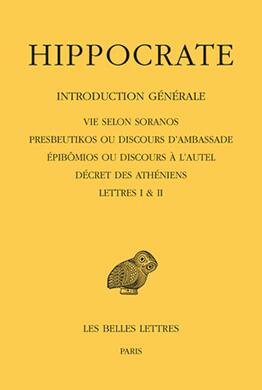
After a brief overview of Hippocrates and his work, this General Introduction brings together the testimonies on Hippocrates’ life and writings, and then examines the history of the Hippocratic text that serves as the basis for the edition.
Hippocrates is the most illustrious physician of ancient Greece. Born in 460 BCE on the island of Cos into a branch of the aristocratic family of the Asclepiads, who claimed descent from Asclepius, he learned medicine from early childhood under the guidance of his grandfather, also named Hippocrates, and his father. He was famous during his own lifetime, as indicated by mentions of him by his younger contemporary Plato in the Protagoras and the Phaedrus. He taught medicine to his two sons and opened his instruction to disciples outside the family, in exchange for payment. He refused to enter the service of the Great King but left his native island for mainland Greece, where he spent part of his career, notably in Larissa in Thessaly, where he died at an advanced age. The body of work preserved under his name – comprising around sixty treatises and currently known as the Hippocratic Collection or Hippocratic Corpus – constitutes the earliest surviving medical writings of Western medicine. Written in the Ionian dialect, like Herodotus’ Histories, these texts are remarkable witnesses to a rational form of medicine, a significant portion of which dates to the second half of the fifth century or the first half of the fourth century BCE.
Jacques Jouanna is Professor of Greek Literature and Civilization at Sorbonne University, former director of the CNRS research unit on Greek medicine (1990–2000), and former president of the doctoral school Ancient and Medieval Worlds. He is a member of the Institut de France, Académie des Inscriptions et Belles-Lettres (elected 1997).