
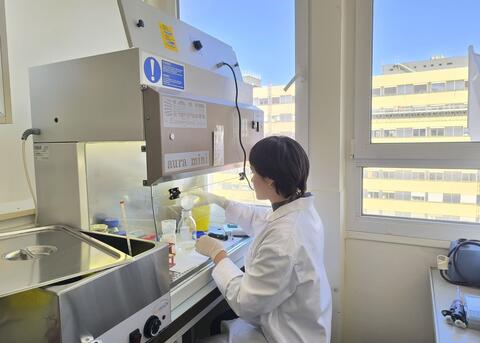
Monitoring Infections through Wastewater: First Results Presented by Pauline Michon in Toulouse
Pauline Michon, a PhD candidate within the OBEPINE network, a research unit of the ASU-GHI, presented the first results of her work at the 28th Journées Francophones de Virologie (Francophone Virology Conference), organized by the French Society for Virology and held from April 22 to 24, 2026, at Toulouse – Jean Jaurès University.
The Francophone Virology Conference is a major event for the French-speaking scientific community. This 28th edition brought together nearly 600 participants for plenary lectures, specialized sessions, and research presentations.
The event also places strong emphasis on early-career researchers, offering dedicated opportunities for scientific exchange and the development of collaborations.

Rethinking infection surveillance: the contribution of wastewater
Pauline Michon’s research is part of the field of wastewater-based epidemiology (WBE). It explores the potential of this approach to transform the surveillance of oncogenic papillomaviruses and, more broadly, pathogens responsible for sexually transmitted infections.
By enabling the analysis of biological signals at the population level, this method opens new perspectives for better understanding the circulation, diversity, and dynamics of these pathogens.
A multi-scale, multi-territory project
These initial findings correspond to the pilot phase of the Papill’Eau project, developed within the OBEPINE+ platform. The project relies on an integrated approach combining multiple levels of observation (wastewater treatment plants, university campuses) and different territories (Paris, Strasbourg, French Guiana).
Monitoring of Parisian sanitation networks and university campuses is supported by the Alliance Sorbonne Université’s Global Health Institute, as well as by the WHAOUH project.
Perspectives for global health
These first results highlight the potential of environmental approaches to strengthen infection surveillance systems and better inform prevention strategies.
The ASU-GHI welcomes this progress, which demonstrates the capacity of research to generate knowledge that is directly relevant to public health and to foster innovative approaches in global health. This work opens promising avenues for the development of enhanced strategies for prevention, protection, and health promotion, particularly among young populations, who are significantly affected by the circulation of human papillomaviruses (HPV). As emphasized by the World Health Organization, HPV transmission is common from the onset of sexual activity.
About the OBEPINE+ Project
Led by Sorbonne University, the OBEPINE+ Project aims to establish a national research and development platform dedicated to wastewater-based epidemiology. This initiative is part of the national framework for the prevention of future emerging infectious diseases and high-risk pathogens, providing a tool capable of early detection and monitoring of epidemics.
