A Look Back at the First Seminar of the Global Health Institute
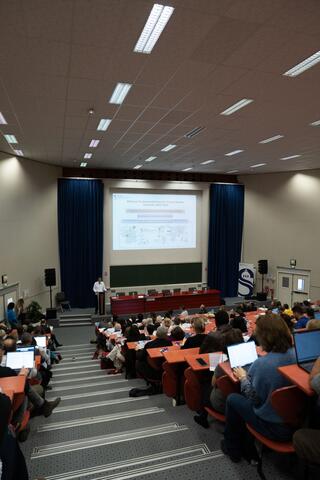
On 10 December 2025, the Alliance Sorbonne Université’s Global Health Institute held its inaugural seminar, marking a fundamental step in the development of a comprehensive approach to health that integrates interdisciplinary research, education and societal engagement.
The Institute's inaugural seminar took place in the Cordeliers, in the Farabœuf Amphitheatre, named after the surgeon and professor of anatomy who worked to democratise his discipline.
The opening remarks highlighted the ambition and foundations of this collective endeavour. Nathalie Drach-Temam, President of Sorbonne University, emphasised the strategic importance of a comprehensive and interdisciplinary approach to health. Bruno Riou, Dean of the Faculty of Health Sciences, highlighted the Institute's structuring role at the crossroads of research, education and contemporary health issues. Renaud Piarroux, President of the ASU-GHI’s Strategic Advisory Committee, placed this work in the context of scientific and societal responsibility, while Juan-Fernando Ramirez, Director of the ASU-GHI, presented the Institute's vision, research axis and ambitions.
Juan-Fernando Ramirez, Director of the Global Health InstituteThe creation of this Institute is more than just an institutional event: it is a commitment. A commitment to developing a culture of health in its entirety, to breaking down barriers between our practices and to working together to find new responses to the challenges of our century.
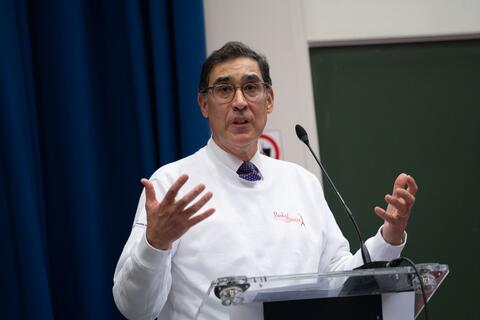
The main contemporary challenges in global health were addressed by Luis Pizarro, Éric Fleutelot and Maria Melchior. They provided complementary perspectives on pandemics, health inequalities, public policy, mental health and the social determinants of health.
The Institute's objectives, “Towards a culture of global health,” were described in more detail by Jean-Michel Oppert, Fabrice Carrat, Françoise Guillo-Benarous and Anne-Lise Paradis. The ambition is clear: to make Sorbonne University and the Alliance a key player in global health, capable of influencing public policy, producing concrete innovations, training new generations and supporting public and private decision-makers.

The seminar also provided an opportunity to present the study programmes and teaching approaches associated with the institute:
- Presentation of the Master’s degree in Biomedical Humanities by Cécilia Bognon-Küss and Alexandre Escargueil, a programme jointly run by the Faculty of Health Sciences and the Philosophy Department of Sorbonne University.
- Presentation of the Master’s degree in Global Health and Emerging Medical Issues by Karine Lacombe and Marie Jaspard. This is the first Master’s degree in Global Health in France, developed under the auspices of the institute.
- A global approach to the patient-caregiver relationship: the example of Serment d’Augusta, a podcast that invites reflection on the future of our healthcare system, presented by one of its producers, Emmanuel Flamand-Roze.
The seminar was punctuated by a moving artistic interlude by the Parkidanse patient group. Under the direction of Professor Emmanuel Flamand-Roze, the Parkinson's Centre of Expertise at La Pitié-Salpêtrière Hospital AP-HP launched dance therapy workshops called “Parkidanse,” offering a non-medical approach to combating sedentary lifestyles and the progression of Parkinson’s disease symptoms.
Nathalie Drach-Temam, President of Sorbonne UniversityThrough their artistic performances, they remind us that health is not limited to healthcare: it is movement, relationships, culture, meaning, and the ability to imagine a better future. This is the promise of the Institute, reflected in its name, “ASU-GUI,” which means “a better future” in Japanese.
The presentations of “My thesis project in global health” by Juliette Garczynski, Louise Simongiovanni, Luna Serou, Veronika Hrebinchuk and Lamine Sane illustrated the disciplinary diversity of research within our institute. By 2025, the Institute had recruited seven doctoral students.
During the round table moderated by Jean-Michel Oppert, discussions focused on the Institute's four main axes of research, which structure its scientific and societal commitment.
- The “Health & Environment” research axis, led by Jean-Baptiste Fini, aims to put prevention back at the heart of health policies, in response to environmental exposures and disruptions that are shaping today's vulnerabilities for tomorrow.
- The “Autonomy – Ageing – Vulnerability” research axis, led by Kiyoka Kinugawa, focuses on supporting healthy ageing throughout life, maintaining the ability to act and ensuring that no one is left behind in the transitions of life.
- The “Cancer” research axis, led by Joseph Gligorov, aims to accelerate innovation, improve screening, treatments and quality of life by placing the patient experience at the centre of research.
- The “Nutrition” research axis, led by Khadija El Hadri-Zegouagh, has a concrete and timely ambition: to sustainably reduce food insecurity among young adults, a major issue in terms of social justice, academic success and well-being.

These themes were further enriched by contributions from Éléonore Bayen, Emmanuel Cohen, Ferdinand Dhombres, Françoise Guillo-Benarous, Catherine Uzan, Catherine Tourette-Turgis, Franck Verdonk, Timothy Van Zandt and Mélodie Tran Thuan, who provided additional insights based on their experiences and areas of expertise.
Among the highlights of the discussion, Catherine Tourette-Turgis, founder of the Université des Patients, forcefully reiterated that ‘we never treat abstract cancer, but always a life trajectory, with its temporality, vulnerabilities, capabilities and social anchors,’ emphasising the central importance of taking the patient into account in all care and research approaches.
Mélodie Tran Thuan, student vice-president of Sorbonne University, shared a worrying observation: the university's services are seeing a continuous increase in the number of scholarship applications and a growing presence of students in food distribution queues. ‘Many tell us they have to choose between eating and studying,’ she warned, pointing out that food insecurity is no longer a marginal phenomenon but now affects the very heart of the university community.
The seminar concluded with a presentation by Claire Rossi, President of the University of Technology of Compiègne and in charge of the institute's research and innovation strategy, who presented the main conclusions and future prospects, thus defining the direction of the next phases of our Institute's development.
Claire Rossi, President of Université de Technologie de CompiègneWhat we have established today is clear: the Institute will not merely observe. It will move forward to reduce inequalities, improve life trajectories, strengthen the resilience of our societies and take care of our most precious common good.