Louise Simongiovanni
PhD Candidate in Medieval Medicine at the ASU-GHI
Doctorant
Biography
Louise Simongiovanni is a PhD student in English medieval literature at the Institute of Global Health (ASU-GHI). She is a member of the Centre for Medieval English Studies (CEMA – UR 2557) and the “Ancient and Medieval Worlds” Doctoral School (ED022). Her supervisors are Prof. Florence Bourgne (Sorbonne University) and Dr Robert Wilkins (University of Oxford).
Her work examines how texts from Early Medieval England (6th–11th centuries) conceptualise and convey practices of care, healing and trust, and explores how these historical models can inform contemporary thinking on the caregiver-care recipient relationship and culturally sensitive approaches to healthcare. Through a transdisciplinary approach combining medieval literature, biomedical humanities and digital humanities, this dialogue between past and present aims to bring forth alternative models of care centred on relationship and listening, at a time when the healthcare system faces major challenges in terms of empathy, cultural pluralism and communication.
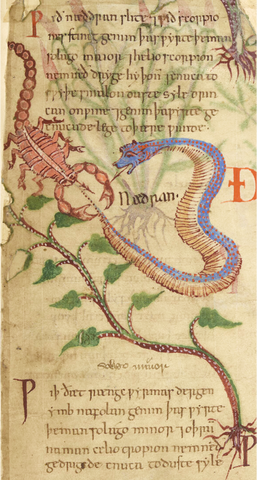
Through this PhD project, Louise aims to contribute to current debates in integrative medicine and healthcare ethics by offering a fresh interpretation of the conceptions of suffering and healing in medieval texts, particularly through the lens of disability studies. The research focuses primarily on leechbooks – collections of Old English remedies – but also, to contextualise these texts, on historical accounts of the period such as the works of the Venerable Bede, hagiographical narratives such as the lives of the saints by Ælfric of Eynsham, theological texts, monastic rules, and a selection of Old English poetry.
In these texts, Louise analyses three main aspects:
- Discourses on the body and healing: conceptions of disability, pain management, narratives of illness and faith.
- Care practices: gestures, postures, interactions, the various beliefs involved, and the contexts in which these practices take place.
- The figures of the carer and the cared-for: who were they? How are they referred to in the texts? What were their roles, their level of agency, and what kind of therapeutic relationship emerges from their portrayal?
The hypothesis underpinning her work is that, in the absence of modern biomedical knowledge, other forms of mediation – symbolic, spiritual and social – took over, and may today inspire more empathetic practices.
Louise is currently particularly interested in the position of patients and their marginalisation in medical texts, their various designations in vernacular language, and the agency that is, or is not, accorded to them.
Furthermore, using textometrics tools, she is currently working on a lexical analysis of her corpus to establish a typology of interactions between patients and the læce (medieval practitioner, “he who advises”). The aim is to define the care relationship as precisely as possible by highlighting all its dimensions: intimate, physical, spiritual, hierarchical, sometimes restrictive, both beneficial yet potentially counterproductive.
Alongside her doctoral research, Louise also teaches: at the Faculty of Arts, where she teaches Old English to third-year BA English Studies students, and at the Faculty of Science and Engineering, where she teaches English to second-year BSc Life Sciences students.