Luna Serou Explores Narrative Medicine to Rethink Healthcare Professionals’ Training
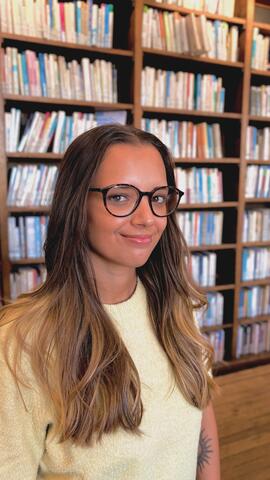
A PhD candidate at the ASU-GHI and the ESSMA research laboratory, Luna Serou is dedicating her doctoral research to narrative medicine and its role in the training of future healthcare professionals. At the crossroads of medicine, anthropology and literature, she explores how the use of narratives can help develop healthcare professionals’ interpersonal skills, listening and empathy, while also contributing to a broader reflection on the meaning of care and healthcare professionals’ well-being.
Could you introduce yourself and tell us briefly about your research project?
My name is Luna Serou, and I am beginning the second year of my PhD within the Alliance Sorbonne Université – Global Health Institute (ASU-GHI) and the ESSMA research laboratory.
I have always wanted to work across different disciplines. I began my studies with a Bachelor's degree in Sociology before pursuing a Master's degree in Anthropology, specialising in “Health, Migration and Mediation”. My Master's dissertation was based on fieldwork conducted in a psychiatric institution, where I followed the daily work of Lucie, an occupational therapist. The aim of this research was to understand how a healthcare professional makes sense of her work and develops her own approach to caring.
These reflections led me to become interested in narrative medicine. Developed in the early 2000s, this approach has a dual objective: to improve the therapeutic relationship by fostering listening and empathy, while also providing healthcare professionals with a space to reflect on the experiences of suffering they encounter in their daily practice. One of its distinctive features is the use, in a clinical context, of tools drawn from literary studies, such as narrative analysis. Through my PhD research, I therefore seek to understand how narrative medicine can be integrated into medical education and contribute to the development of relational clinical skills among future healthcare professionals.
Why did you choose to work on this topic and pursue your PhD within this research laboratory?
In 2024, as I was beginning the first year of my Master's degree, I learned that my mother had been diagnosed with cancer. Since then, I have supported her on a daily basis as a family caregiver. This experience placed me in a rather unique position: I found myself simultaneously on the side of patients and their families and, through my research, on the side of healthcare professionals. I was therefore able to observe, from both perspectives, some of the difficulties currently affecting our healthcare system: a lack of communication, exhaustion, overstretched services, waiting and uncertainty surrounding test results, and, at times, the feeling that patients and families are not sufficiently heard in their experience of illness. These experiences led me to reflect on how we can better support people facing illness, while also taking into account the realities and constraints faced by those who care for them. A few years later, discovering narrative medicine resonated strongly with these personal reflections. I then met Jean-Sébastien Cadwallader and Isabelle Galichon, and our discussions around this approach gradually led to the development of my PhD project, which they now supervise.
As for the Global Health Institute, my research topic is closely aligned with its mission, particularly its commitment to promoting more equitable health and improving healthcare. My research explores how the training of healthcare professionals can contribute to the development of more sustainable approaches to care. This perspective also connects with the research conducted within the ESSMA team.
After your first year as a PhD candidate, what are the main discoveries, skills or experiences you take away from this stage of your research journey?
During this first year, I focused on the first strand of my PhD: assessing the impact of narrative medicine workshops implemented in paediatrics at Bordeaux University Hospital on residents’ well-being, by comparing their situation before and after taking part in the workshops. The initial findings suggest that residents engage with these workshops in different ways. They can provide a space for sharing, learning and creativity, while at times also confronting participants with experiences that unsettle or challenge them. This approach responds to a need to give greater meaning to medical education and professional practice beyond the acquisition of technical skills, by creating space to explore a more sensitive and subjective dimension of care. The findings also highlight certain tensions: in a medical culture that remains largely focused on performance and efficiency, giving greater attention to these dimensions can generate both enthusiasm and forms of resistance.
I have also been able to develop and consolidate new skills, both in conducting research and in analysing and communicating my findings. I have had the opportunity to attend several conferences and seminars, where I presented my work and exchanged ideas with researchers and healthcare professionals about the challenges and opportunities surrounding healthcare education.
© Photo credit: Luna Serou