
Louise Simongiovanni: Rethinking Care Through the Suffering Body in the Middle Ages
A PhD candidate in Medieval Literature at Sorbonne Université, Louise Simongiovanni explores healthcare practices and representations of the suffering body in early medieval England. At the intersection of medieval studies and the medical humanities, her research examines how illness, vulnerability and the relationship between caregivers and patients were understood between the 6th and 11th centuries, while also exploring what these historical perspectives on care can teach us about contemporary healthcare practices.
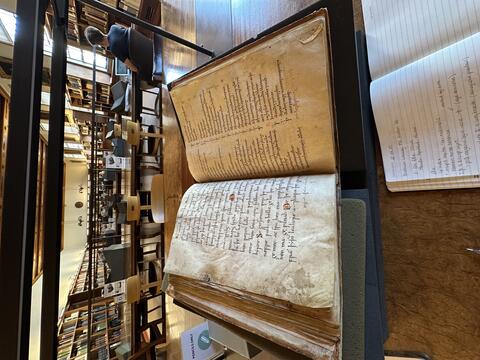
Right: Oxford, Bodleian Library, MS Hatton 76
Could you introduce yourself and tell us briefly about your research project?
I am a PhD candidate in Medieval Literature at Sorbonne Université and have been working within the Global Health Institute since September 2025. After completing my first Master's degree at Sorbonne Nouvelle, where I worked on disability in the Middle Ages, I joined Sorbonne Université in 2024 to pursue a second Master's degree and specialise in Old English, the language spoken in England from the 5th to the 12th century. It was during this year that I learned about the launch of the Global Health Institute and developed my PhD project with the Institute's research priorities in mind.
My research focuses on healthcare practices and representations of the suffering body in early medieval England, between the 6th and 11th centuries. Drawing on medical texts written in Old English, as well as literary and religious texts, I seek to understand how illness and healing were conceived, how the relationship between caregivers and patients was understood, what forms their actions and words took, and how vulnerable bodies were cared for.
My project lies at the intersection of medieval studies and the medical humanities. In particular, I aim to bring the patient's voice to the fore in texts that are often studied primarily from the perspective of medical knowledge or their magical and religious dimensions. In the longer term, I would like to explore what these historical understandings of care can teach us about contemporary healthcare practices, particularly about the relationship between caregivers and patients.
Why did you choose to work on this topic and pursue your PhD within this research centre?
I chose this topic as a continuation of my previous work on disability, because the history of medicine is not simply a history of knowledge and treatments: it is also a history of the human relationships surrounding illness and suffering. Early medieval medical texts provide insight into a wide range of healthcare practices, but also into how sick people were addressed, how their symptoms were interpreted, and how vulnerable bodies were cared for.
I am a member of CEMA, the Centre d'Études Médiévales Anglaises (UR 2557), the only research centre in France specifically dedicated to the study of medieval England. As I work on Old English texts, joining CEMA was an obvious choice for me. But, above all, being part of Sorbonne Université gave me the opportunity to join the Global Health Institute and bring a genuinely interdisciplinary dimension to my research. My project draws on literary and historical texts, while engaging in dialogue with health sciences, Disability Studies and contemporary thinking about the caregiver-patient relationship. This dialogue is essential to my approach: the aim is not to look to the Middle Ages for ready-made solutions to contemporary medicine, but rather to compare different ways of thinking about care in order to raise new questions about our current practices.
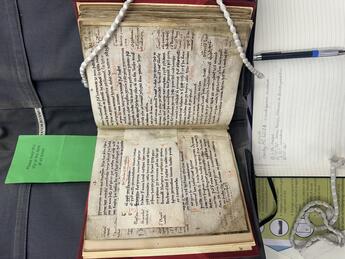
Below: London, British Library, Harley MS 6258 B
After your first year as a PhD candidate, what are the main discoveries, skills or experiences you take away from this stage of your research journey?
This first year has above all taught me how to allow a research question to evolve through engagement with texts and with other disciplines. I began exploring my corpus of Old English medical texts and had the opportunity to undertake research stays in London, where I studied manuscripts at the British Library, and in Oxford, at the Bodleian Library. Holding thousand-year-old manuscripts in my hands while approaching them with contemporary questions was an incredible experience. Paleographical study of these medieval texts was combined with digital analysis of my corpus and close reading. This approach enabled me to identify patterns and key words, examine the terms used to refer to patients, and develop a typology of caregivers' actions.
I have also learned a great deal through exchanges with researchers from different backgrounds and by attending conferences in France and England. Working within the Global Health Institute has encouraged me to move beyond the traditional boundaries of literary studies and to think more deeply about how research in the humanities can engage in dialogue with the health sciences and contribute to contemporary issues.
Finally, this first year has helped me better define what I hope to achieve through my PhD: not only to study how medieval societies understood care, but also to demonstrate how history and the humanities can help us reflect on our contemporary relationship with the body, vulnerability and the experience of care.
© Photos credit: Louise Simongiovanni